A windshield crack spread typically occurs due to rapid temperature changes, moisture penetration, and physical vibrations from driving on uneven roads. In Houston, the transition from hot days to cooler fall nights causes glass to expand and contract; this constant movement quickly turns a minor chip into a major safety hazard. Drivers should address small damages immediately, as high-speed wind pressure and road debris can cause existing cracks to grow across the entire glass surface in seconds.
It begins as a small, barely noticeable rock chip from a highway commute, but in Houston, a minor blemish rarely stays small for long. You might notice that tiny fracture stretching across your field of vision after a particularly humid afternoon or a sudden October cold front. This phenomenon is known as crack spread; it is a structural failure accelerated by the unique thermal stresses of our Gulf Coast climate. Ignoring a growing crack compromises your vehicle’s structural integrity and may lead to costly citations under Texas law. In this guide, we explain the specific science behind why chips expand during the Houston fall transition. You will learn how to distinguish between repairable damage and necessary replacements, understand the legal implications of driving with obstructed glass, and discover immediate steps to halt further damage before your next appointment at A.B.A Auto Services.
The Science Behind Why a Windshield Crack Spreads in Houston
Automotive glass is engineered to be incredibly strong, but it is also a stressed material. During the manufacturing process, windshields are tempered and laminated to handle significant structural loads and wind resistance. When the glass is intact, this internal tension is distributed evenly across the surface. However, the moment a stray rock creates a small chip, that uniform strength is compromised. The chip acts as a structural focal point, concentrating all the latent stress of the glass into one microscopic area.
In Houston, the primary catalyst for a windshield crack spread is the extreme thermal cycle. While technicians in northern states often focus on freezing temperatures, our local glass faces a different battle: rapid expansion and contraction driven by high humidity and radical temperature swings. On a typical October afternoon, the sun can heat your dashboard and windshield to well over 100 degrees. If a sudden Gulf thunderstorm rolls in, the external temperature might drop to 60 degrees in less than twenty minutes.
This creates a literal tug of war within the glass layers. The outer layer of glass tries to contract rapidly as it is cooled by the rain, while the inner layer, still insulated by the cabin's residual heat, remains expanded. Because the chip has already broken the structural integrity of the pane, the glass cannot absorb this conflicting movement. The stress has nowhere to go but out, forcing the chip to run and turn into a full crack.
At A.B.A AUTO SERVICES, we see how Houston's heavy humidity exacerbates this physics problem. Moisture acts as a wedge. High humidity levels allow water vapor to permeate the damaged area more easily than in drier climates. As temperatures fluctuate, this moisture puts constant pressure on the edges of the damage. Understanding these physics is why we offer a comprehensive range of automotive services designed to address glass damage before the Houston weather takes control of your repair costs.
The Houston Fall Transition: Why October is Risky for Rock Chips
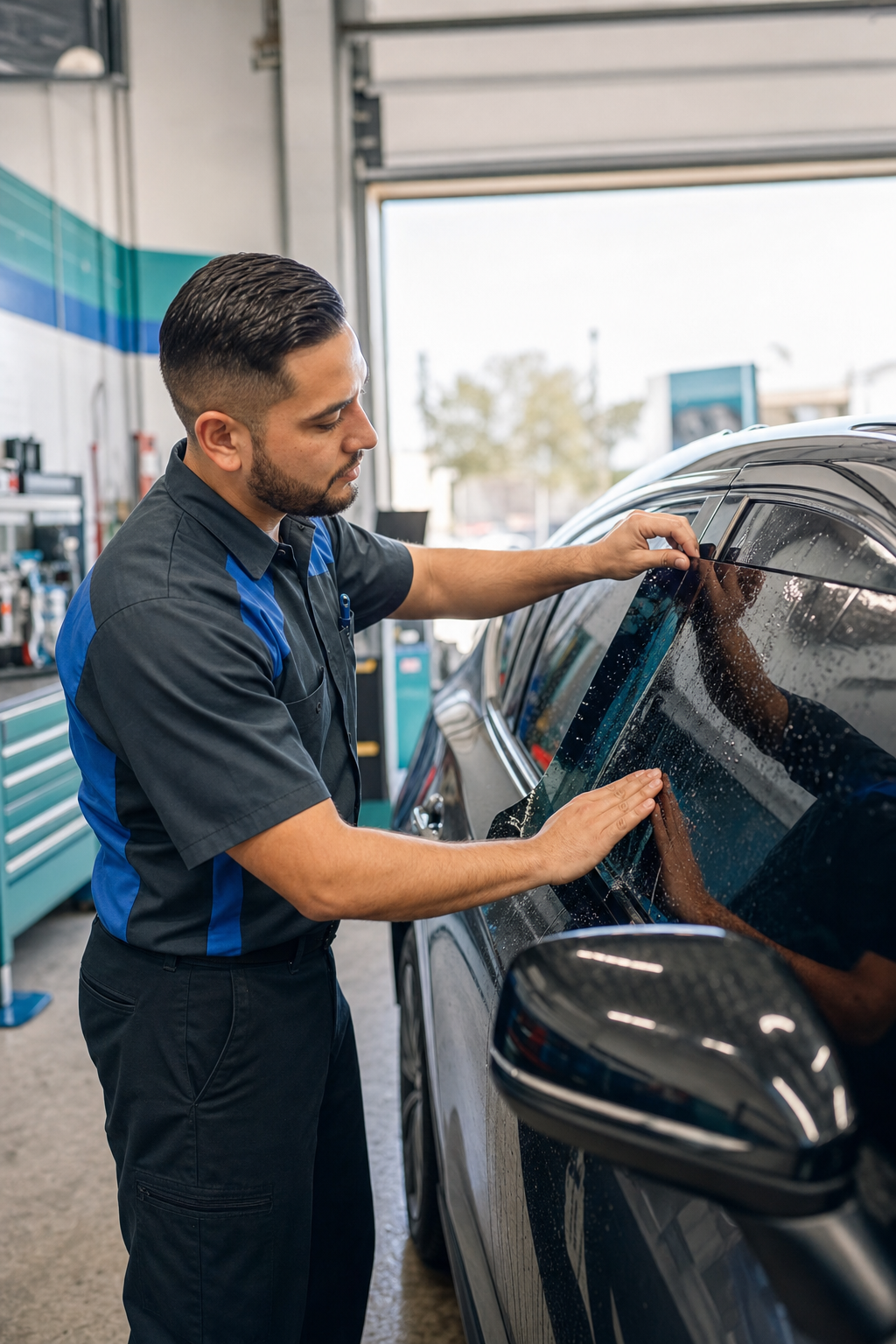
October in Houston represents a high-risk period for automotive glass. The transition from the sweltering summer to the volatile fall weather creates the perfect conditions for a windshield crack spread. This month is particularly dangerous because of the drastic temperature fluctuations experienced during a single commute.
Imagine a typical morning heading out on the Westpark Tollway or Beltway 8 at 7:30 AM. It is a crisp 60 degrees, and you likely run the defroster to clear the morning dew from the glass. By the time you head home at 4:30 PM, the Texas sun has baked the asphalt, and you are blasting the AC to combat 90-degree heat. This rapid shift creates what technicians call thermal shock. When cold air hits the interior side of a sun-soaked windshield, the glass layers flex at different rates. If a rock chip is present, this microscopic movement acts like a lever, forcing the damage to grow instantly.
Houston’s persistent humidity adds another layer of structural danger. High moisture levels allow water vapor to seep deep into the laminate layer of a chip. As you move between the humid exterior air and the dry, conditioned air inside the cabin, this trapped moisture puts constant pressure on the edges of the break. Small chips that survived the steady heat of August often fail in October because they can no longer withstand this constant mechanical cycling. Before a sudden morning cold front turns a minor pit into a spiderweb, you should contact us for a glass assessment to determine if a simple repair can still save the pane.
How Fast Does a Windshield Crack Spread While Driving?
A common question we hear on Dunlap St is just how fast does a windshield crack spread once it starts. The reality for many drivers is that the transition from a minor pit to a full spiderweb happens in a heartbeat. While some damage might appear stable for days, the mechanical stresses of daily driving in Houston can force a crack to run across the entire glass in seconds.
Road vibration is the most immediate threat. When you are traveling at highway speeds on I-10 or I-610, your vehicle is subjected to constant micro-oscillations. If you hit one of Houston's notorious potholes or an uneven expansion joint, that physical shock travels through the frame and directly into the glass. Since the windshield is a structural element of the car, it absorbs this energy. A crack that was only an inch long can instantly snap across the pane when the glass flexes to accommodate the bump.
Wind pressure and cabin physics also play a role. At 70 MPH, the air pushing against your windshield exerts significant force, which can be the literal breaking point for a weakened chip. Even something as simple as slamming your car door creates a sudden spike in internal air pressure. This pressure exerts outward force on the glass, often causing an existing crack to "run" to the edge. If you notice any new damage, it is critical to contact us for a glass assessment before your next commute turns a repairable chip into a necessary replacement.
Types of Damage: Bullseye, Star, and Edge Cracks
Identifying the specific shape of your glass damage helps predict how it will behave under the stress of a Houston commute. A bullseye, characterized by a circular break with a dark ring, is often the most stable; however, it easily traps the local humidity that eventually forces the glass layers apart. More aggressive is the star break, which features several microscopic fractures, or legs, radiating from the impact point. These legs are high risk because each one represents an active pathway for a windshield crack spread.
The most critical category is the edge crack. Because your windshield is bonded directly to the vehicle frame with a high-strength urethane adhesive, it is subject to the structural torsion of the car. Any damage located within three inches of the perimeter is almost guaranteed to run because it absorbs the direct mechanical stress of the frame as the vehicle turns or hits a bump on the Beltway. These cracks compromise the structural integrity of the safety glass much faster than center-pane damage. Understanding these distinctions is a core part of how we evaluate safety on Dunlap St. If you have noticed a star or an edge fracture, you should contact us for a glass assessment immediately to see if the glass can be saved before it reaches the driver's line of sight. You can learn more about our Houston shop and our specialized approach to these common local road hazards.
Windshield Repair vs. Replace: The Houston Driver's Criteria
Deciding whether to repair or replace is a matter of safety and structural physics. For Houston drivers, a professional repair is typically viable if the damage is minor. We use the quarter rule here on Dunlap St; if a rock chip is smaller than a twenty-five-cent coin, it can usually be filled with high-grade resin to restore its strength. However, the location matters just as much as the size. If the chip is directly in the driver’s line of sight, a repair may not be recommended. Even the best resin can leave a slight distortion that might catch the glare of the Texas sun, creating a dangerous distraction during your commute.
Replacement becomes mandatory once the damage exceeds specific safety thresholds. If you see a windshield crack spread longer than six inches, which is roughly the length of a dollar bill, the structural integrity of the laminate is compromised beyond the point of a safe patch. You should also consider the quantity and location of the impacts. If your windshield has sustained three or more separate chips, the cumulative weakening of the glass makes it prone to failure. Furthermore, any crack that reaches the very edge of the glass necessitates a full replacement because the bonding point to the vehicle frame is no longer secure.
At A.B.A AUTO SERVICES, we provide a comprehensive range of automotive services to help you navigate these decisions. Because of Houston's high humidity and intense heat, a chip that qualifies for repair today could easily become a replacement job tomorrow. We recommend that you contact us for a glass assessment at our shop on Dunlap St as soon as you notice damage. Our technicians will inspect the depth and location of the break to ensure your vehicle remains safe for the road.
Is it Illegal to Drive with a Cracked Windshield in Texas?
Texas law does not explicitly forbid all windshield cracks, but the Texas Department of Public Safety (DPS) enforces strict visibility standards. Under the Texas Transportation Code, any vehicle equipment that is damaged in a way that blurs or obscures the driver’s vision is considered a violation. This means a law enforcement officer has the discretion to pull you over and issue a citation if they believe your windshield damage constitutes a safety hazard, especially if the crack reflects glare into your eyes during the bright Houston afternoons.
The most common legal complication for local drivers occurs during the annual state inspection. A windshield crack spread that interferes with the path of the windshield wipers or enters the acute area directly in front of the driver will typically result in an automatic failure. Because A.B.A AUTO SERVICES provides state and commercial emission inspections on Dunlap St, we see firsthand how many residents are forced into emergency repairs just to keep their registration current. If a crack has moved into your primary line of sight, it is no longer just a cosmetic issue; it is a regulatory one. Ensuring your glass meets these safety requirements is part of our comprehensive range of automotive services. If you are unsure if your vehicle will pass, you can contact us for a glass assessment before your inspection date.
Immediate Steps to Stop a Windshield Crack from Spreading
If you spot a new chip while driving through Houston, taking immediate action can buy you critical time before a full windshield crack spread occurs. Start by parking your vehicle in a garage or a shaded area. Direct sunlight on a hot Texas afternoon accelerates glass expansion, which forces fractures to grow. You should also adjust your climate control to avoid blasting the air conditioner directly at the glass; the sudden temperature differential is a common trigger for failure.
Applying a small piece of clear packing tape over the damage is a vital temporary measure. This prevents Houston’s high humidity and road grime from entering the break, which keeps the glass clean enough for a high quality repair later. Avoid high pressure car washes, as the water force can easily split the laminate. Most importantly, do not attempt to use over the counter resin kits on cracks longer than an inch. These retail products often fail to bond correctly under the intense Gulf Coast heat. For a professional solution, you should contact us for a glass assessment at our Dunlap St location. Our team offers a comprehensive range of automotive services to ensure your vehicle is safe and road-legal. You can learn more about our Houston shop and our commitment to quality repairs before a minor issue turns into a costly replacement.